Smart rings — small, wearable bands worn on your finger that contain optical sensors — have quietly become one of the fastest-growing categories in personal health technology. The pitch is elegant: instead of a watch on your wrist or a strap across your chest, you wear something that looks like ordinary jewelry, and it tracks your heart rate, heart rate variability (HRV), sleep, and recovery around the clock. HRV, for the uninitiated, is a measure of the tiny time differences between heartbeats — wider variation generally signals a well-recovered, resilient nervous system, while compressed variation can flag fatigue, stress, or illness. It’s one of the most actionable biometrics a health-focused person can track. The question this article answers directly: can a finger-worn optical sensor deliver HRV and heart-rate data you can actually trust and act on — and where does it genuinely fall short compared to a chest strap or a medical-grade ECG device?
If you’re already tracking HRV with a Polar H10 or eyeing the AliveCor KardiaMobile for arrhythmia documentation, this review is written for you. We’ll work through the sensor physics, the accuracy evidence, the total-cost picture, and land on explicit “if X, then Y” decision rules.
| EDITOR'S PICK[EMAY 6L Portable ECG Monitor](https://www.amazon.com/dp/B0C88W44M2?tag=greenflower20-20) | Mid-tier[RQZ Smart Ring Fitness Tracker](https://www.amazon.com/dp/B0H4GGZQSV?tag=greenflower20-20)… | Budget pick[KardiaMobile 1-Lead EKG Monitor](https://www.amazon.com/dp/B0C36HF2TJ?tag=greenflower20-20) | |
|---|---|---|---|
| Channel count | 6 | — | 1 |
| FDA cleared | — | — | ✓ |
| Waterproof | — | 5 ATM | — |
| Subscription required | No | — | — |
| Form factor | Portable monitor | Ring | Pocket device |
| Price | $169.00 | $109.60 | $79.00 |
| See on Amazon → | See on Amazon → | See on Amazon → |
How Smart Ring Sensors Actually Work — and Why the Finger Is Both an Advantage and a Constraint
Every smart ring on the market today — including the Oura Ring 4, the Samsung Galaxy Ring, and the RingConn Gen 2 — uses photoplethysmography, or PPG. The ring shines LEDs (typically green, sometimes infrared) into the skin on the underside of your finger and measures how much light bounces back. Blood volume changes with each heartbeat, so the reflected light pulses in rhythm with your heart. Algorithms then extract beat-to-beat intervals from that optical waveform.
The finger is, physiologically, a better PPG site than the wrist. Blood vessels run closer to the surface, there’s less subcutaneous fat to scatter the signal, and the finger moves less erratically during many activities than the wrist does. Published research supports this advantage: a 2024 study in the International Journal of Sports Physiology and Performance (Plews et al.) found that smart ring PPG captured overnight HRV values that correlated reasonably well with chest-strap ECG during sleep, with mean absolute errors that were meaningfully lower than typical wrist-worn optical devices. That’s a genuine win for the form factor.
The constraint is equally real, though. PPG is an indirect measurement. It infers inter-beat intervals from optical pulses rather than measuring the heart’s electrical signal directly. During exercise — especially anything above moderate intensity — motion artifact corrupts the optical signal. Algorithms smooth it, but smoothing introduces latency and can flatten or miss the beat-to-beat variation that makes HRV useful. The result: smart ring HRV data during active workouts is generally not reliable for real-time training decisions. Where rings perform best is the window they’re purpose-built for: low-motion overnight sleep and early-morning resting measurements.
Where the Data Is Actually Good: Resting HRV, Sleep Staging, and Recovery Scores
The legitimate use case for smart ring cardiac data centers on three applications, each with different levels of evidence behind them.
Overnight HRV and resting heart rate are where rings earn their keep. Because you’re lying still and asleep, motion artifact drops out, the optical signal stabilizes, and beat-to-beat interval extraction becomes far more reliable. Wareable’s Oura Ring 4 review notes that overnight resting heart rate readings showed strong agreement with reference chest-strap measurements across reviewers. The Mayo Clinic’s overview of HRV monitoring notes that resting and nocturnal measurements are the most clinically meaningful HRV windows precisely because activity-related noise is absent — which maps cleanly onto what rings do well.
Recovery and readiness scores are the proprietary layer that companies like Oura, Samsung, and RingConn build on top of raw HRV. These composite indices blend HRV, resting heart rate, temperature deviation, respiratory rate, and sleep quality into a single daily number. They’re useful behavioral nudges — TechRadar’s 2025 smart ring roundup consistently notes that users find readiness scores actionable even when they don’t dig into raw HRV figures — but they are algorithmic products, not clinical measurements. Two rings measuring the same person on the same night can produce noticeably different readiness scores because each company’s weighting formula is proprietary and unpublished.
Sleep stage tracking (light, deep, REM classification) is a third area where rings have improved substantially. Finger-based PPG captures respiratory rate and heart rate variation through the night with enough fidelity to support reasonably accurate sleep staging. No smart ring achieves polysomnography-level precision, but for tracking your own trends over weeks and months, the data is directionally reliable.
By the Numbers
| Use Case | Ring PPG Reliability | Better Alternative |
|---|---|---|
| Overnight resting HRV | Moderate–Good | Polar H10 (chest strap, morning spot check) |
| Active workout HRV/HR | Poor–Moderate | Polar H10 or Garmin HRM-Pro |
| Arrhythmia documentation | Not suitable | AliveCor KardiaMobile 6L (FDA-cleared ECG) |
| Sleep trend tracking | Moderate–Good | Ring is a reasonable primary tool |
Where Rings Still Fall Short: Exercise, Arrhythmia Detection, and Clinical Acceptance
During exercise, the motion artifact problem is not fully solved. PCMag’s Samsung Galaxy Ring review notes that real-time heart rate during high-intensity intervals showed more variance against a chest-strap reference than the brand’s marketing suggests. Published specs put exercise HR accuracy in the ±5–10 bpm range under ideal conditions, but that range widens with wrist movement analogs (gripping a barbell, swinging a kettlebell). If your training program depends on staying in precise HR zones, a ring is a supplement, not a replacement for a chest strap.
Arrhythmia detection is where the gap between marketing and clinical reality is sharpest and most consequential. Several smart rings now advertise AFib (atrial fibrillation) detection features. As of May 2026, these features operate via PPG-based irregular rhythm detection — not single-lead ECG. The FDA’s Digital Health Center of Excellence de novo classification database lists PPG-based AFib detection products under a wellness/general wellness regulatory pathway in most cases, not as FDA-cleared diagnostic tools equivalent to a single-lead ECG patch. The practical implication: if you or a family member has documented arrhythmia and needs recordings a cardiologist can import, interpret, and act on clinically, a smart ring does not meet that bar. The AliveCor KardiaMobile 6L ($150) and the Wellue DuoEK ($200) produce actual single-lead ECG traces that can be exported as PDFs or HL7 files for physician review. Smart ring “AFib alerts” may prompt you to seek evaluation — that’s genuinely valuable as a screening nudge — but they are not a substitute for device-captured ECG strips.
Subscription costs deserve honest accounting. Oura Ring 4 requires a $5.99/month membership to unlock most HRV trend views and readiness scoring beyond the raw data. Samsung Galaxy Ring ties advanced analytics to a Galaxy ecosystem membership structure. Over a three-year ownership horizon, that subscription can add $215 or more to the total cost — comparable to the ring’s hardware price itself. RingConn has differentiated itself by offering lifetime data access without a mandatory subscription, which TechRadar reviewers flag as a meaningful practical advantage for budget-conscious buyers.
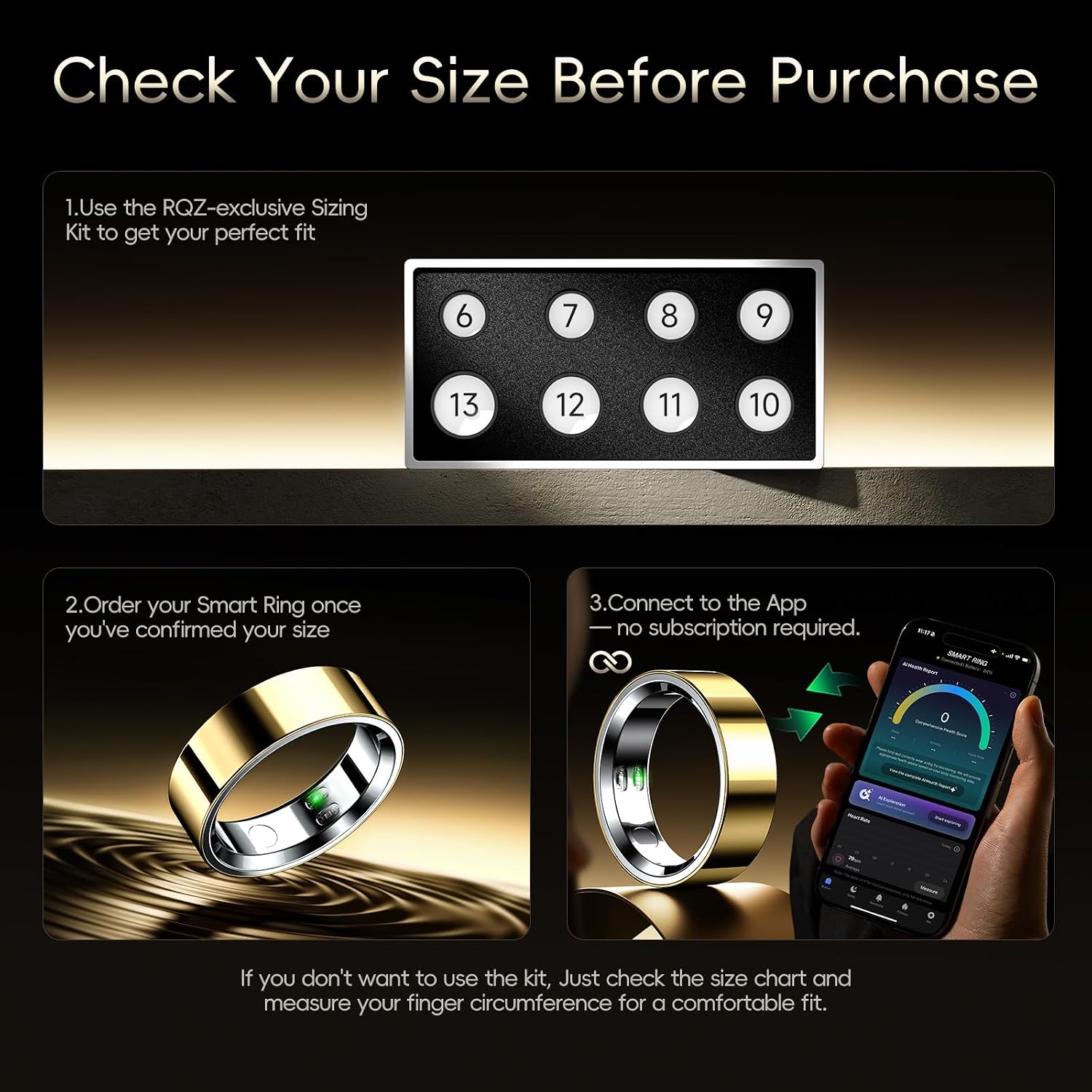
Ring sizing and sensor contact are underappreciated friction points. The optical sensor must maintain consistent contact with the underside of your finger. Fingers swell in heat and shrink in cold; several Oura owners in long-run reviews note needing a second sizing kit after seasonal changes. Most brands offer a free sizing kit before purchase, and using it is not optional — it’s essential to data quality.
Total Cost of Ownership: The Realistic Three-Year Picture
Because smart rings are not cheap entry points, it’s worth mapping the full spend:
- Oura Ring 4 (hardware): approximately $350–$400 at launch; subscription adds ~$216 over three years → ~$566–$616 total
- Samsung Galaxy Ring: approximately $400 hardware; ecosystem membership costs vary → budget $500+ over three years
- RingConn Gen 2: approximately $200–$250 hardware; no mandatory subscription → ~$200–$250 total
Compare that to a Polar H10 chest strap at ~$90 with no subscription and multi-year strap durability, or a KardiaMobile 6L at ~$150 with optional Kardia Premium at ~$99/year if you want AI analysis. For a patient or caregiver focused on AFib documentation, $150 + optional subscription delivers clinical-grade utility the ring cannot match at any price.
The Decision Rules
Smart ring data is legitimate and useful within its window. Here’s where it earns a place in your monitoring stack — and where it doesn’t:
If you want overnight HRV trend tracking and sleep staging in a low-profile, always-on device, and you’re comfortable with a proprietary readiness algorithm rather than raw ECG data → a smart ring is a defensible primary tool. Oura Ring 4 leads on ecosystem maturity and research partnerships; RingConn Gen 2 leads on three-year total cost.
If you train with intensity and need real-time heart rate zone accuracy during workouts → pair the ring with a chest strap for training sessions. The ring handles sleep and recovery; the strap handles the gym. This is the stack most serious athletes reviewing both categories land on.
If you or a family member are managing documented AFib or another arrhythmia and need device recordings a cardiologist can clinically interpret → a smart ring is not your primary tool. The KardiaMobile 6L or Wellue DuoEK are the right devices. A ring can sit alongside them as a passive overnight monitor, but it cannot replace an ECG-capable device for arrhythmia management.
If your quantified-self stack already includes a chest strap and a continuous SpO2 monitor like the Wellue O2Ring → evaluate whether a smart ring adds genuinely new data or just duplicates it in a more expensive form factor. For many multi-device users, the ring’s primary unique contribution is finger-based overnight HRV with less sleep disturbance than a chest-strap, which is a real benefit — but only if overnight HRV is a gap in your current stack.
Smart rings have earned a real role in cardiac self-monitoring. The sensor physics on the finger genuinely is better than the wrist. The overnight use case genuinely is well-matched to PPG’s strengths. But the category still has honest limits: exercise accuracy is mediocre, clinical ECG documentation is out of scope, and subscription costs add up faster than most buyers model upfront. Match the tool to the actual need, and a ring can be a smart addition. Assume it does everything, and you’ll be working around its gaps within a month.