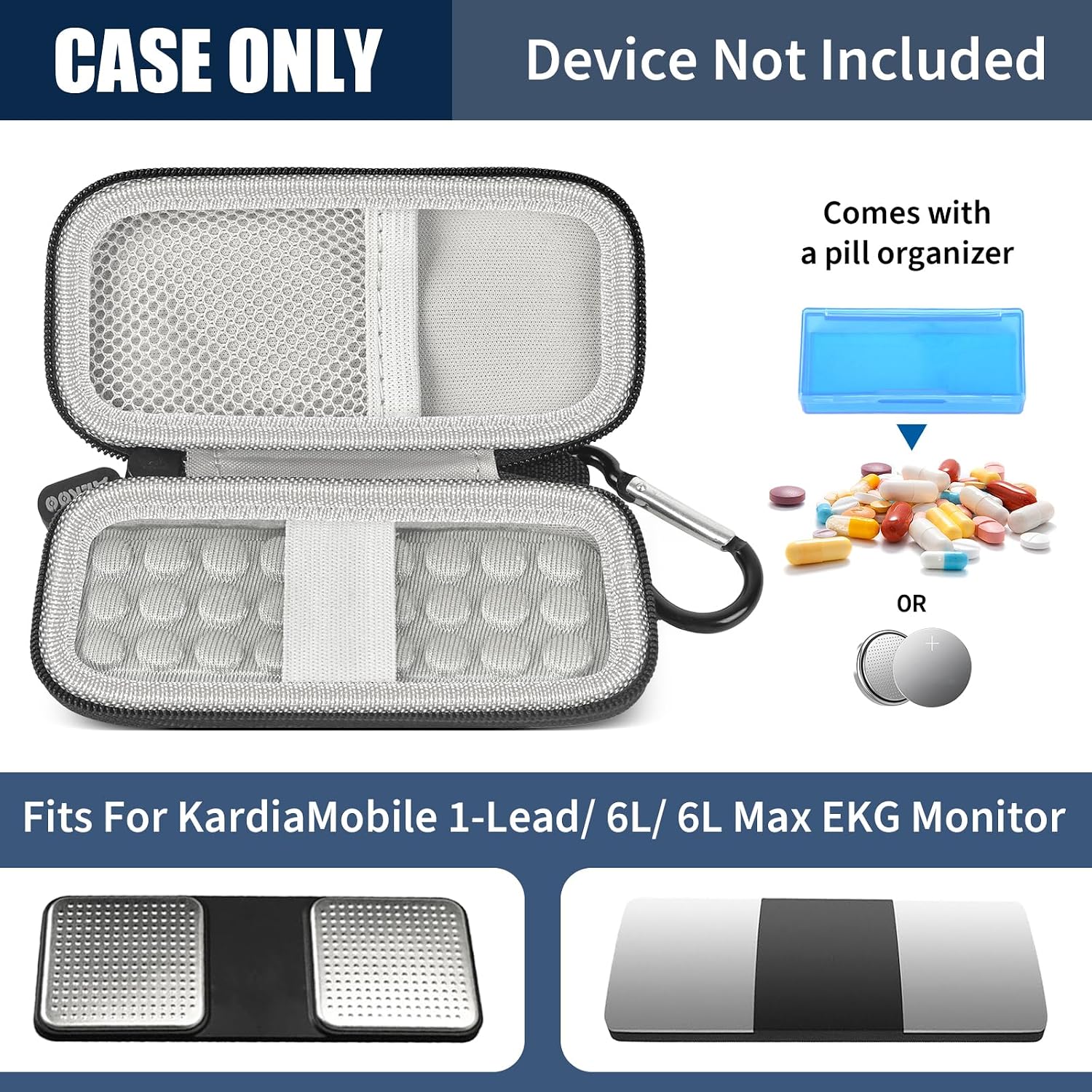
You spent real money on a portable ECG monitor — a device that records your heart’s electrical activity (the same signal a cardiologist reads as a squiggly line called an electrocardiogram, or ECG) so you can capture and share episodes of irregular rhythm wherever you are. Whether that’s an AliveCor KardiaMobile 6L, an EMAY EMG-10, or a Wellue DuoEK, the whole value proposition depends on the device being with you and intact when a symptom shows up. That’s where protective cases and carry accessories come in — and where most buyers discover that generic “electronics pouches” either don’t fit these oddly shaped devices or offer false confidence. This guide breaks down the specific dimensions, tradeoffs, and accessory categories that actually serve the Kardia and EMAY form factors, so your investment survives daily carry.
Why Generic Cases Fail These Specific Devices
Portable ECG monitors are dimensionally awkward relative to mainstream consumer electronics. They’re not cards, they’re not earbuds, and they’re not pens. Each device has a distinct footprint that trips up generic pouches.
By the numbers — device dimensions that drive case selection:
| Device | Approximate Dimensions | Key Physical Challenge |
|---|---|---|
| KardiaMobile (single-lead) | 83 × 33 × 3 mm | Ultra-flat; slips around inside standard pouches |
| KardiaMobile 6L (six-lead) | 83 × 56 × 5 mm | Wider paddle shape; most phone-adjacent cases too narrow |
| EMAY EMG-10 | ~112 × 68 × 14 mm | Thicker than either Kardia; needs structured rather than soft-sided case |
| Wellue DuoEK | ~88 × 56 × 12 mm | Mid-form; fits some Kardia cases but loses snug fit at lid |
Per AliveCor’s published product documentation, the 6L is specifically the wider of the two KardiaMobile variants — 56 mm versus 33 mm for the single-lead card. That 23 mm difference disqualifies the majority of “credit card” cases marketed as Kardia-compatible. Buyers who discover this only after purchase — a pattern noted consistently across aggregated reviews on major retail platforms — typically report the device rattling loose inside the case or electrode pads picking up debris.
The EMAY EMG-10, per EMAY’s product documentation and user manual, adds a third dimension challenge: its 14 mm body depth means soft fabric pouches don’t lie flat and tend to create pressure points on the snap electrodes over time. Reviewers at Wareable and PCMag who cover cardiac wearables both note that physical electrode condition is a direct determinant of trace quality — a scratched or contaminated electrode pad will produce artifact in the recording that a cardiologist may flag as uninterpretable.
The implication is straightforward: case selection is not aesthetic. It’s a direct upstream variable in recording quality.
Case Categories Worth Considering — and One to Skip
Hard-Shell EVA Cases (Best for EMAY EMG-10 and Multi-Device Setups)
EVA (ethylene-vinyl acetate) is the semi-rigid foam-and-shell material used in camera lens pouches and hearing aid cases. It’s the right category for the EMAY EMG-10 because the device’s depth and electrode snap points need structure, not compression.
What to look for in this category: interior foam cutouts (or moldable foam you cut yourself), external zipper that doesn’t drag over the interior, and a footprint in the 130 × 90 × 25 mm range to accommodate the EMG-10 with its lead wires coiled alongside.
Owners consistently report that cases in the “small electronics organizer” segment — often marketed for hearing aids, blood glucose meters, or small digital cameras — map to EMAY dimensions better than cases marketed specifically as “ECG monitor cases,” which often assume Kardia geometry. The tradeoff: EVA cases add visible bulk to a bag or jacket pocket. They’re not the right choice if the device is clipped to a gym bag and needs to stay flat.
Slim Hard-Shell Clamshells (Best for KardiaMobile 6L)
The 6L’s paddle shape — wider than a credit card but thinner than a phone — fits best in clamshell cases designed for USB drives or short-run electronics. The target interior: 90 × 60 mm minimum, with shallow depth (6–8 mm). This category protects the electrodes from the primary real-world failure mode owners describe: keys and coins in the same pocket scratching the electrode surface.
One important qualifier: the 6L ships with an optional sticker mount that attaches the device to the back of a phone case, which AliveCor’s product documentation lists as the default carry method for many users. If you’re using the phone-mount approach, the case category shifts entirely — you’re protecting the electrode face specifically, and a stick-on silicone cover or a phone case with a dedicated card slot becomes the operative accessory rather than a standalone pouch.
Soft Zipper Pouches with Interior Dividers (Best for Full Travel Kit)
If you’re carrying the monitor plus a charging cable, spare electrode pads (relevant for the EMAY EMG-10), printed PDF records, or a USB stick with backup recordings, a soft organizer pouch with internal elastic loops becomes the practical daily-carry solution. The FDA’s guidance on patient-generated cardiac data (per FDA.gov’s digital health documentation) notes that continuity of records is clinically meaningful for arrhythmia management — keeping your PDFs and device together in one travel kit is a workflow choice with real clinical upside.
The tradeoff with soft pouches: zero crush resistance. In a bag with a laptop or water bottle, compression can bend the KardiaMobile card or stress the EMAY’s electrode connections. These are kit-bag or briefcase solutions, not pocket solutions.
What to Skip: Universal “Tech Pouches” Marketed as ECG-Compatible
This category is worth naming explicitly because it captures a high share of first-purchase mistakes. Universal tech pouches — typically 150 × 100 mm nylon, sold under various brand names on major retail platforms — market themselves with ECG monitor photos in the listing imagery but size to a generic “small electronics” template. They’re too large to grip the Kardia devices without compression padding, too shallow for the EMAY EMG-10, and often use metal zipper pulls that create exactly the scratch risk you’re trying to avoid. Across aggregated reviews, the complaint pattern is consistent: the device moves around, the electrode surface contacts the zipper track, and within weeks the trace quality degrades.
Lead Wire Management: The Underrated Accessory Category
If you own an EMAY EMG-10 or a Wellue DuoEK — both of which use physical lead wires rather than the KardiaMobile’s direct-touch paddle design — lead wire storage is arguably more important than the case itself.
Lead wires fail at the connector end first. Repeated coiling under tension stresses the insulation at the point where the wire meets the snap connector. Owners in long-run reviews consistently note this as the primary hardware failure mode — not the device body, not the display, but the wires. The fix is a storage approach that uses large-diameter coils (no tight wrapping around the device body) and a separate elastic loop or Velcro tie to secure the coil without crimping.
Silicone cable ties — the flat, reusable type used for audio cables — are consistently recommended in quantified-self community discussions as the right tool here. They grip without biting into the insulation, release cleanly, and add negligible bulk. This is a sub-$10 accessory decision with outsized impact on device longevity.
The total cost of ownership math is direct: replacement lead wires for the EMAY EMG-10 are available at roughly $15–$25 per set, and EMAY’s documentation recommends periodic replacement as part of routine maintenance. A $8 set of silicone cable ties and a disciplined coiling habit materially extends the interval between replacements.
A Decision Framework: Matching Case to Use Case
The tradeoff matrix isn’t complicated once you name the variables explicitly.
If your primary use is symptom capture at rest (desk, bedside, clinic waiting room): The KardiaMobile 6L on a phone mount with a scratch-cover for the electrode face is the lowest-friction solution. A hard-shell clamshell for transport when the phone mount isn’t in use covers the gap. Total accessory spend: $15–$30.
If your primary use is travel and multi-day cardiac event logging with the EMAY EMG-10: A structured EVA hard-shell sized to the device with foam cutouts, plus a soft organizer pouch for the full travel kit (cables, spare pads, printed reports), is the right two-piece setup. Per the FDA’s 510(k) clearance documentation for devices in this class, maintaining electrode condition is essential for producing recordings a cardiologist can act on — the case choice directly supports that clinical requirement. Total accessory spend: $25–$50.
If you’re managing documented atrial fibrillation and sharing recordings regularly with a care team: The clinical workflow benefit of organized, labeled, intact records is documented. NYTimes Wirecutter’s coverage of ECG monitors (updated 2025) notes that AliveCor’s PDF output is designed for physician review — keeping that PDF workflow intact means the device, its charging cable, and a printed or digital record-keeping system travel together. A labeled soft pouch that holds the full kit in one place is the right category, sized to your bag rather than your pocket. Budget $20–$40 and prioritize labeled interior dividers over brand name.
If you’re a prosumer building a multi-device monitoring stack: You likely already have a travel organizer that handles your O2Ring, HRV chest strap, and related accessories. The question becomes whether your existing organizer has a slot that protects electrode surfaces specifically. If not, a single hard-shell insert for the ECG device within a larger organizer is the right incremental investment — not a second full travel kit.
The underlying principle across all three device categories is the same: these devices earn their keep by being ready when you need them. A KardiaMobile 6L with scratched electrodes or an EMAY EMG-10 with stressed lead wires won’t produce a clean trace at the moment that matters — and a cardiologist reviewing artifact-heavy output has less to work with than one reviewing a clean 30-second strip. The case isn’t the exciting part of portable cardiac monitoring. But it’s quietly load-bearing in a way that most buyers only recognize after their first degraded recording.