If you’ve ever clipped a heart rate monitor to your ear or fumbled with a chest strap mid-warmup, you already understand the appeal of an optical armband. These are wearable bands — worn on your upper arm or wrist — that use LED light to estimate your heart rate by detecting blood-flow changes beneath the skin. No gel pads, no electrodes, no shirt adjustment required. You just strap it on and pedal. For Peloton riders and Zwift cyclists (Zwift is an online virtual-cycling platform where your real-world power and heart rate show up on screen as a digital avatar), the armband pitch is simple: comfort plus compatibility. But the marketing tends to gloss over a critical gap — optical sensors and electrical sensors are fundamentally different technologies, and that difference matters enormously when the data is driving your training zones or your cardiologist’s next question.
This guide is for riders who’ve moved past the “any number is fine” phase. You’re already tracking zones, suspicious when your Peloton leaderboard heart rate drifts 15 beats in a single interval, and wondering whether your current armband is the problem or whether you’re just expecting too much from the category. We’ll break down what the tech can and can’t do, show you exactly where armbands lose to chest straps, and give you a clear decision framework for your specific use case.
| EDITOR'S PICK[Polar Verity Sense - Optical He…](https://www.amazon.com/dp/B08TRGNGF6?tag=greenflower20-20) | Mid-tier[Scosche Rhythm+ 2.0 Heart Rate…](https://www.amazon.com/dp/B08BNB2N5C?tag=greenflower20-20) | Budget pick[CYCPLUS Heart Rate Monitor Armb…](https://www.amazon.com/dp/B0DLNMMY9M?tag=greenflower20-20) | |
|---|---|---|---|
| Wireless | ANT+ BLE | BLE ANT+ | BLE ANT+ |
| Water rating | — | IP68 | IP67 |
| LED indicator | — | — | ✓ |
| HRV/RRi data | — | ✓ | — |
| Price | $89.95 | $49.99 | $39.99 |
| See on Amazon → | See on Amazon → | See on Amazon → |
How Optical Armbands Actually Work — and Where the Physics Fight Back
Every optical heart rate monitor — whether it’s on your wrist, your upper arm, or a fingertip clip — uses a method called photoplethysmography (PPG). Green LEDs shine into your skin; a photodetector picks up light that bounces back. Because blood absorbs green light more than surrounding tissue, each heartbeat creates a detectable pulse in that returning signal. The sensor’s algorithm converts those pulses into a beats-per-minute number.
The accuracy problem isn’t the concept — it’s the interference. During intense exercise, arm motion creates what researchers call “motion artifact”: your muscles moving, veins shifting, and skin pressure changing all produce signals that look disturbingly similar to a heartbeat to the sensor’s algorithm. A 2017 study published in Medicine & Science in Sports & Exercise — Gillinov et al., “Variable Accuracy of Wearable Heart Rate Monitors during Aerobic Exercise,” indexed on PubMed at ncbi.nlm.nih.gov — found that consumer optical HR monitors showed mean errors ranging from roughly 5% to over 34% depending on exercise intensity and device, with the largest errors occurring precisely during high-intensity intervals — the moments when accurate heart rate data matters most.
Upper-arm placement does help compared to wrist placement. The brachial artery in the upper arm runs closer to the surface than the radial arteries typically tracked at the wrist, and the upper arm moves less violently than the wrist during cycling. That’s the genuine engineering advantage armbands have over smartwatches for this application. But it doesn’t eliminate motion artifact — it reduces it. Reviewers at Wareable, in their roundup “Best heart rate monitors 2025: chest straps, armbands and watches tested” (wareable.com), consistently note that upper-arm optical sensors outperform wrist-based optical sensors during high-cadence efforts while still lagging behind chest-strap electrical monitors in spike detection and beat-by-beat precision.
The other underappreciated variable is latency. Optical algorithms typically average over a 5–15 second rolling window to smooth out motion artifact noise. That averaging introduces lag. When you surge on a Zwift sprint segment, your actual heart rate may spike to 178 bpm while your armband is still reading 161 bpm — a ten-second window behind reality. For aerobic steady-state rides, this barely matters. For interval training or VO2 max work where your coach or app is using real-time heart rate to gate rest periods, that lag is functionally a different metric than what a chest strap reports.
Peloton and Zwift Compatibility: What “Works With” Actually Means
Both Peloton and Zwift accept heart rate data via two wireless protocols: ANT+ and Bluetooth Low Energy (BLE). Most modern armbands support one or both. This is where “compatible” marketing claims deserve scrutiny — technically transmitting a signal the platform receives is not the same as transmitting an accurate signal the platform can use meaningfully.
Peloton specifics: The Peloton bike and Tread natively read BLE heart rate signals. If your armband broadcasts over BLE, Peloton will display it. The platform uses that number to populate your Output/Heart Rate graph and, for some programming, to suggest resistance adjustments. A consistently lagging or motion-artifact-prone armband means your heart rate graph will show artificially smooth curves that don’t reflect the intensity spikes your body actually experienced — which can make your performance data look better than it is and undermine any zone-based training structure.
Zwift specifics: Zwift accepts both ANT+ (via a USB dongle on PC/Mac) and BLE (natively on iOS, Android, and Apple TV). ANT+ dual-band armbands are particularly valued by the Zwift community because ANT+ allows one device to broadcast to multiple receivers simultaneously — so your Zwift session and a separate head unit can both read your heart rate without pairing conflicts. PCMag, in “The Best Heart Rate Monitors for 2025” (pcmag.com), notes that ANT+ transmission remains the preferred protocol among serious cyclists and triathletes using multi-device setups.
Accuracy at a glance — upper-arm optical vs. chest strap:
| Scenario | Chest Strap (e.g., Polar H10) | Upper-Arm Optical (e.g., Wahoo TICKR FIT) |
|---|---|---|
| Steady-state Zone 2 error | ~1–2 bpm | ~3–7 bpm |
| High-intensity interval error | ~2–3 bpm | ~8–20+ bpm |
| Signal latency | Near real-time | 5–15 sec averaged |
| HRV capability | Yes (beat-by-beat R-R) | Limited / no |
Sources: Stahl et al., “Accuracy of Optical Heart Rate Sensing Technology in Wearable Fitness Trackers for Young to Middle-Aged Adults,” JMIR mHealth and uHealth, 2016, indexed on PubMed at ncbi.nlm.nih.gov; and Polar H10 Heart Rate Sensor Technical Specifications, polar.com (plain-text reference).
The Contenders: Three Tiers Worth Your Consideration
Budget Pick — Scosche Rhythm24 (~$60–$70)
The Rhythm24 has a loyal following among indoor cyclists for its dual-band ANT+/BLE transmission and waterproofing rated to 100 feet — useful if your post-ride cooldown involves a pool. Its 24-hour battery life is the lowest of the three options reviewed here, but owners across cycling communities consistently report reliable pairing with both Peloton (via BLE) and Zwift (via ANT+ dongle or BLE). The optical sensor performs acceptably at Zone 2 aerobic intensities; the same high-intensity motion-artifact caveats that affect the entire optical category apply here. For a rider whose primary goal is steady-state aerobic training on a budget, the Rhythm24 earns its place.
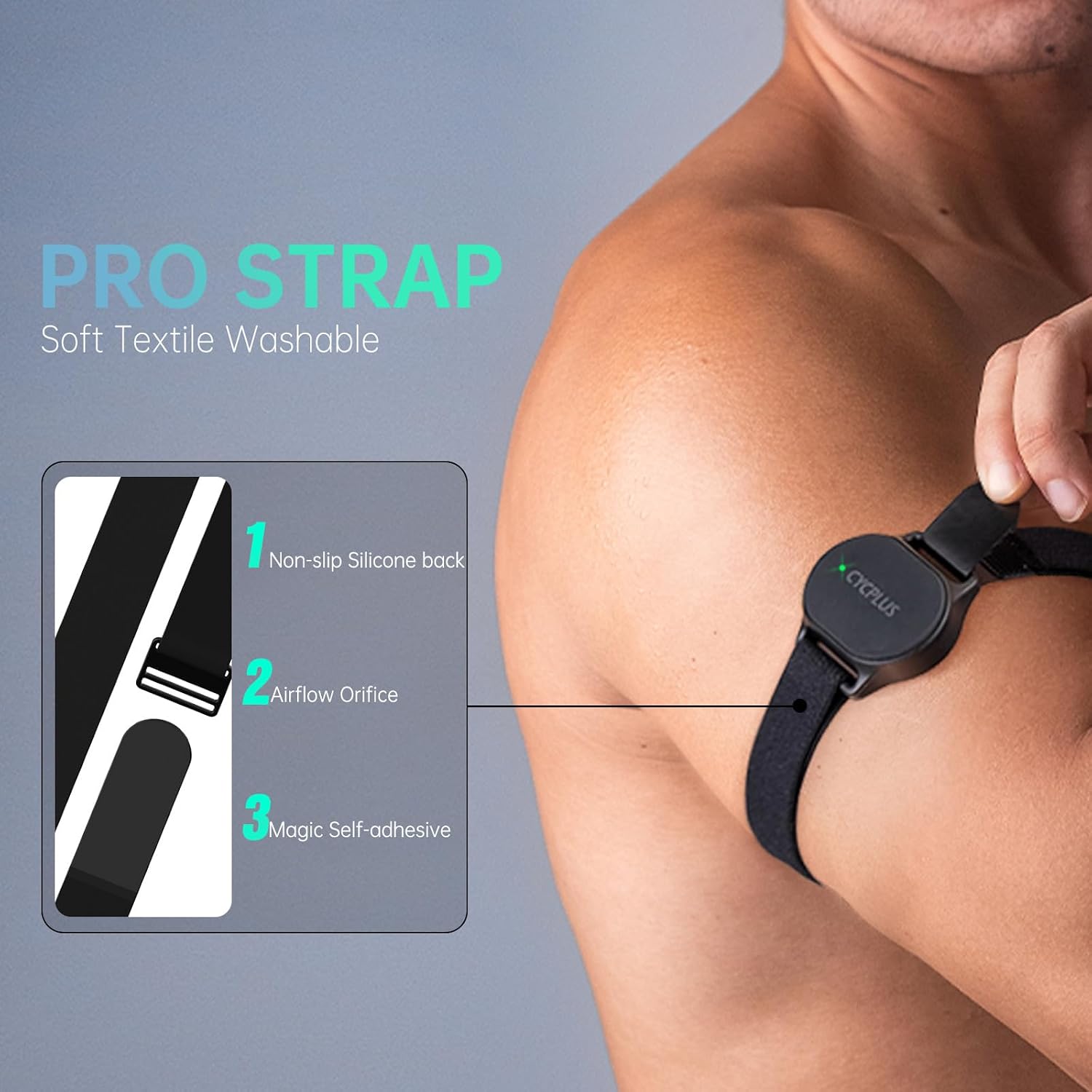
CYCPLUS
$39.99
In stock on Amazon
Check price on AmazonMid-Tier Pick — Wahoo TICKR FIT (~$79)
The TICKR FIT is probably the most frequently recommended upper-arm optical monitor for indoor cycling specifically because it broadcasts both ANT+ and BLE simultaneously, pairs reliably with Peloton via BLE and Zwift via either protocol, and sits in a comfortable price range. Wareable’s 2025 heart rate monitor roundup (wareable.com) positions it as a strong upper-arm option for cyclists who want dual-band flexibility without moving to a chest strap. Battery life is rated at 30 hours, which is meaningful for longer virtual race events. At Zone 2 efforts, most owners report solid numbers; at threshold and above, the optical lag discussed earlier becomes noticeable. If you’re doing mostly aerobic work with occasional intervals and you value strap-free comfort, the TICKR FIT is the straightforward mid-range pick.
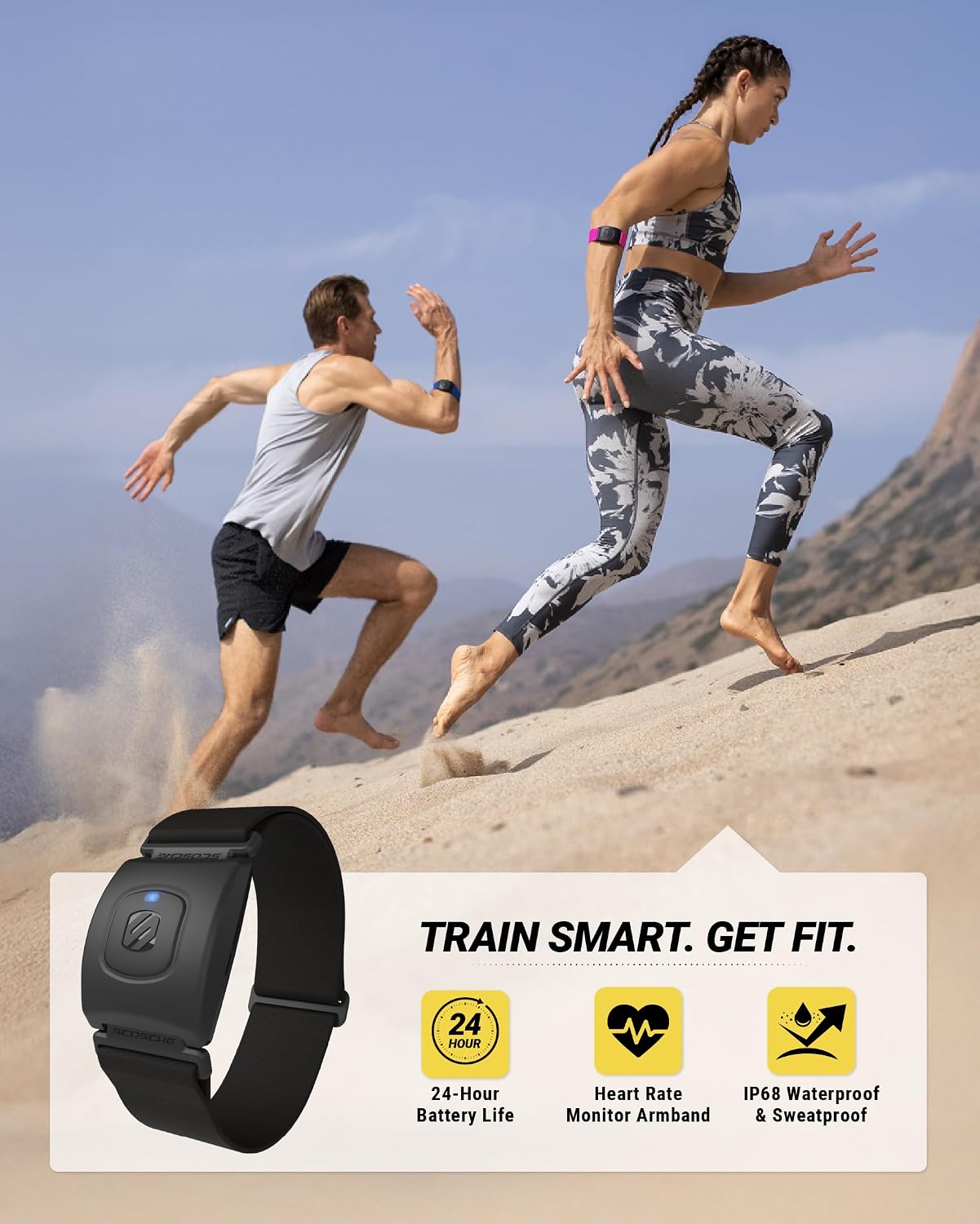
Scosche
$49.99
In stock on Amazon
Check price on AmazonPremium Optical Pick — Polar OH1+ (~$79–$89)
Polar’s optical armband benefits from the company’s long history in sport heart rate hardware. The OH1+ uses six LEDs rather than the two-to-four common in budget options, which improves signal quality in lower-perfusion conditions such as cold training rooms. It also stores data internally for up to 200 hours and syncs via Bluetooth — useful if your Zwift setup doesn’t maintain a persistent BLE connection throughout a session. Compatibility covers both ANT+ and BLE. Among upper-arm optical options, reviewers at Wareable (wareable.com) and PCMag (pcmag.com) rate it as one of the more reliable performers for sustained aerobic work. The same high-intensity accuracy ceiling affects this device as every optical armband, but within the optical category, the six-LED array earns its premium positioning.
Polar
$89.95
In stock on Amazon
Check price on AmazonWhat Armbands Cannot Do — and When to Step Outside the Category
None of the above produce clinically usable ECG data. If you or someone you support has documented atrial fibrillation or an arrhythmia requiring monitoring, an optical armband is categorically the wrong device — regardless of price point. That’s a separate category anchored by FDA-cleared devices (see FDA.gov’s digital health center for cleared cardiac monitor listings) whose output a cardiologist can actually interpret. Marketing materials for optical armbands sometimes use the word “accurate” in ways that blur this distinction; keeping the categories clearly separated in your own decision-making is worth the effort.
Heart Rate Variability (HRV) tracking presents a related limitation. HRV calculation requires beat-by-beat R-R interval data — the precise timing between each heartbeat. Optical PPG sensors typically cannot cleanly resolve this, especially during or immediately after exercise. If you’re using HRV as part of a recovery stack, a chest strap with R-R export capability is the architecture that actually works. The Polar H10 (approximately $89–$99, per Polar’s published H10 Technical Specifications at polar.com) remains the benchmark here: beat-by-beat R-R interval data, simultaneous ANT+ and BLE, and a track record in peer-reviewed accuracy comparisons that no optical armband in the sub-$150 range has matched, per the Gillinov et al. findings published in Medicine & Science in Sports & Exercise and indexed at ncbi.nlm.nih.gov.
The Decision Framework: If X, Then Y
If your primary use is Zone 2 aerobic training on Peloton or Zwift — steady-state efforts at 60–75% of max heart rate — an upper-arm optical armband is a reasonable choice. The accuracy error at lower intensities is small enough that your training zones remain meaningful. The Wahoo TICKR FIT or Polar OH1+ are the straightforward picks: both dual-band, both well-reviewed by Wareable and PCMag, both priced around $79.
If you’re doing structured interval work — VO2 max sets, sprint intervals, race simulations on Zwift — and you’re using real-time heart rate to gate your efforts, an optical armband will consistently underperform. An 8–20 bpm error range during high-intensity intervals isn’t a minor rounding issue; it’s the difference between training in Zone 5 and training in Zone 4. In this scenario, a chest-strap electrical monitor is the right tool. The Polar H10 remains the benchmark: it’s the device most frequently cited in peer-reviewed accuracy literature indexed on ncbi.nlm.nih.gov and recommended in consumer roundups at both Wareable and PCMag. Chest straps are mildly less convenient, but the accuracy gap justifies the tradeoff the moment your training prescription relies on real numbers.
If cost is the primary constraint and you’re a Zone 2 rider, the Scosche Rhythm24 in the $60–$70 range is serviceable — but verify pairing reliability with your specific Peloton or Zwift hardware setup before committing. Reviews at Wareable (wareable.com) note that cheaper optical sensors can struggle more with lower-perfusion conditions and with armband fit variation, both of which affect signal quality.
The marketing on optical armbands is broadly honest about features and largely silent about limitations. Knowing which limitations matter for your specific training context is the gap this guide is designed to close.