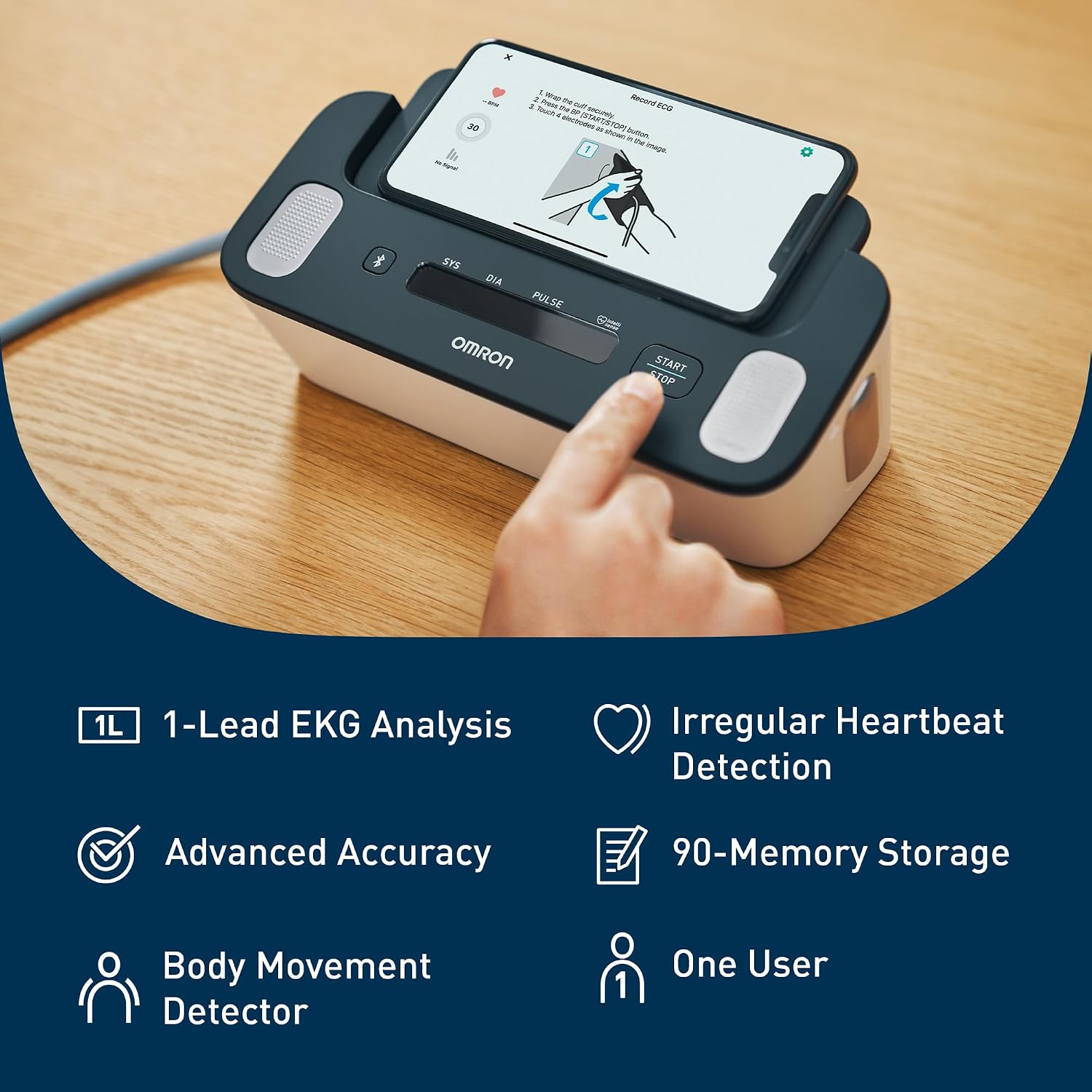
If you have ever had a doctor ask you to track your blood pressure at home — the force your blood exerts against your artery walls, measured in millimeters of mercury (mmHg) — you may have wondered whether you could also capture an ECG at the same time. An ECG, or electrocardiogram, is a recording of the electrical signals your heart produces with every beat; it is the same test a doctor orders to check for atrial fibrillation (AFib), an irregular heartbeat that significantly raises stroke risk. Until recently, those were two separate devices, two separate workflows, and two separate apps. A new category of combo monitors changes that: one arm cuff, one reading, two clinically meaningful data points. This article sizes up the two most credible options on the market right now — the OMRON Complete and the Withings BPM Connect — so you can decide which, if either, belongs in your monitoring stack.
Both devices are squarely aimed at the overlap of this site’s primary audiences: the fitness-focused adult who wants richer data than a wrist optical sensor can deliver, and the patient or caregiver managing documented AFib who needs recordings a cardiologist will actually accept. We will cover FDA clearance status, clinical acceptance, app ecosystem, total cost of ownership, and the decision rules that separate one device’s ideal buyer from the other’s.
What “Combo Monitor” Actually Means — and What It Does Not
Before comparing specs, it is worth being precise about what these devices measure and how, because the marketing copy around this category is genuinely muddy.
A conventional upper-arm blood pressure cuff uses oscillometry — it inflates, then deflates while a pressure sensor detects oscillations (small pulses) in the artery beneath the cuff. From those oscillations it derives systolic (peak pressure) and diastolic (resting pressure) readings. That process is passive; it does not require any electrical contact with your skin.
An ECG requires electrical contact. The OMRON Complete adds two electrodes to the cuff itself — one on the inner surface that touches your left arm, one on a small pad you press with your right hand — completing a single-lead circuit. This is the same principle behind the AliveCor KardiaMobile: a Lead I ECG, measuring the electrical potential between your left arm and right hand. It is not a 12-lead clinical ECG, but it is a real electrical recording, not an optical approximation. Per the Mayo Clinic’s overview of ECG methodology, a single-lead recording is sufficient for rhythm analysis — detecting AFib, bradycardia, tachycardia, or a normal sinus rhythm — though it cannot diagnose structural issues or locate the precise zone of a cardiac event the way a full 12-lead can.
The Withings BPM Connect, by contrast, is not an ECG device in any clinical sense. Withings markets it with health-scoring features and irregular heartbeat detection, but that detection is derived from pulse wave analysis during the oscillometric reading — an optical/pressure method, not an electrical one. It does not produce an ECG waveform. This distinction is the single most important fact in this article: one of these devices captures a rhythm strip your cardiologist can read; the other flags anomalies but cannot show them one.
FDA Clearance and Clinical Acceptance: The Line That Matters
For patients managing AFib or any documented arrhythmia, FDA clearance is not a checkbox — it determines whether your monitoring data has any clinical standing.
OMRON Complete holds FDA 510(k) clearance (K192557) for both its blood pressure and ECG functions. The ECG output is a PDF rhythm strip generated through the OMRON Connect app; per PCMag’s review of the OMRON Complete, the strip format is compatible with standard cardiologist workflows, and several reviewers note their physicians accepted the exports. OMRON’s own documentation describes the ECG as capable of detecting AFib and producing a shareable PDF — the same deliverable that makes AliveCor’s KardiaMobile useful in clinical practice.
Withings BPM Connect is FDA-cleared for blood pressure measurement only. The irregular heartbeat detection feature is not FDA-cleared as a diagnostic tool. Harvard Health Publishing’s 2024 overview of wearable AFib detection explicitly distinguishes between optical pulse-irregularity flagging and single-lead ECG recording, noting that only the latter produces data cardiologists can act on with confidence.
The practical implication: If you are monitoring under a cardiologist’s direction — for paroxysmal AFib, post-ablation surveillance, or any condition where rhythm documentation matters — the OMRON Complete is the only one of these two devices that delivers a clinically actionable artifact. The Withings BPM Connect is a wellness device with a blood pressure monitor inside it. That is a legitimate product; it just serves a different buyer.
Head-to-Head: Specs, App Ecosystem, and Total Cost of Ownership
By the Numbers
| OMRON Complete | Withings BPM Connect | |
|---|---|---|
| Street price (May 2026) | ~$100–$130 | ~$100 |
| ECG type | Single-lead (Lead I), FDA-cleared | None (pulse flagging only) |
| BP validation | FDA 510(k) cleared | FDA 510(k) cleared |
| App | OMRON Connect (iOS/Android) | Withings Health Mate |
| Subscription required | No | No (optional Withings+ at ~$10/mo) |
| PDF export for physician | Yes — ECG rhythm strip | No ECG; BP history export only |
| Cuff size range | 9–17 inches (standard adult) | 9–17 inches (standard adult) |
| Battery | 4 AA batteries | Rechargeable USB-C |
Both devices land in roughly the same price bracket — you are not paying a meaningful premium for the OMRON Complete’s added ECG capability, which makes the comparison less about budget and more about what you actually need from the device.
App Ecosystem
The OMRON Connect app is functional but utilitarian. Across aggregated user reviews on both major app platforms, the consistent praise is for data reliability and PDF generation; the consistent friction point is the interface’s dated feel compared to more modern health platforms. OMRON Connect does integrate with Apple Health and Google Fit, so if your primary tracking ecosystem is a wearable like an Apple Watch or Garmin, your BP and ECG records can flow into a unified timeline.
Withings Health Mate is, by most accounts, the more polished consumer experience. Wareable’s roundup of blood pressure monitors with smart features consistently highlights Health Mate’s trend visualization and the way it contextualizes readings against activity data from other Withings devices. If you already own a Withings Scale or Sleep Analyzer, the BPM Connect deepens that ecosystem meaningfully. The optional Withings+ subscription (~$10/month as of early 2026) adds health coaching and trend reports; it is not required to use the device but is worth surfacing in any total-cost-of-ownership calculation.
Measurement Workflow
One workflow consideration that aggregated reviews surface repeatedly for the OMRON Complete: the ECG requires you to hold your right hand against the cuff pad for roughly 30 seconds after the blood pressure reading completes. Owners consistently report that this is straightforward once habitual but can feel awkward for first-time users. The device prompts you through it step by step, so it is not a barrier — just a calibration of expectations. You are doing two measurements sequentially in one sitting, not truly simultaneously.
Where Each Device Wins: Decision Rules
Given the spec picture above, the decision tree is fairly clean.
Choose the OMRON Complete if:
- You are monitoring under a cardiologist’s direction and need rhythm strip PDFs they will accept.
- You have documented AFib, palpitations, or a family history that warrants real electrical rhythm capture, not just irregularity flagging.
- You prioritize clinical defensibility over app elegance.
- You do not already own a dedicated ECG device like an AliveCor KardiaMobile and want to consolidate your upper-arm BP workflow with single-lead ECG in one device.
Choose the Withings BPM Connect if:
- Your goal is blood pressure trend monitoring and wellness logging, without a clinical-grade ECG requirement.
- You are already embedded in the Withings ecosystem and want seamless data continuity with Health Mate.
- You value a rechargeable device (the USB-C battery is a real-world convenience advantage over 4 AA batteries).
- Your cardiologist has not asked for rhythm strip documentation and AFib is not a current clinical concern.
Consider neither if:
- You need multi-lead ECG capability, 7- to 14-day continuous Holter-style monitoring, or ambulatory readings across active daily life. Neither device is worn continuously; both require a deliberate seated measurement. For that use case, devices like the Emay EMG-10 or Wellue DuoEK exist in their own category and price tier.
- You are trying to replace wrist-based HRV tracking for athletic performance optimization. A chest strap like the Polar H10 remains the gold standard for R-R interval precision that HRV calculations depend on; neither of these upper-arm cuffs generates HRV data.
The Overlooked Cost: What Happens After the Purchase
Neither device requires recurring consumables in the way that clinical Holter recorders require electrode pads, which is a genuine total-cost-of-ownership advantage for both. Replacement cuffs for the OMRON Complete run approximately $20–$30 if the standard cuff does not fit; Withings offers a similar range for the BPM Connect. Both use standard upper-arm cuff sizing, so third-party options are widely available.
The Withings+ subscription deserves a second mention here. It is optional — the device works fully without it — but Withings has a documented pattern of gating its more analytical features behind the subscription tier, per Wareable’s 2025 review coverage. If you find yourself relying on Health Mate’s deeper trend analysis, budget for that ongoing cost. Over 24 months, an unsubscribed Withings BPM Connect and a subscribed one diverge by roughly $240 in total spend — enough to have paid for the OMRON Complete with money left over.
The American Heart Association recommends measuring blood pressure at roughly the same time each day for reliable trending (per their Understanding Blood Pressure Readings guidance). Both devices facilitate this with reminders; the OMRON Connect’s reminder system is noted as more configurable in head-to-head user feedback, a minor but real usability point.
The Bottom Line
The OMRON Complete and the Withings BPM Connect occupy the same approximate price point but serve meaningfully different needs. The OMRON Complete is the more clinically serious device: its FDA-cleared single-lead ECG produces a cardiologist-ready rhythm strip, and its blood pressure measurement is equally validated. For anyone with a documented arrhythmia concern or a physician asking for rhythm documentation, it is the clear choice. The Withings BPM Connect is the better consumer wellness device: cleaner app, rechargeable battery, and a richer ecosystem — but its “irregular heartbeat detection” is a wellness flag, not a clinical ECG, and buyers who conflate the two may find themselves with a monitoring gap they did not know existed.
If you are building a monitoring stack around a real cardiac concern, the OMRON Complete earns its place. If you are building a wellness dashboard and blood pressure trending is the primary goal, the Withings BPM Connect is the more pleasant daily-use device. The two products look similar from the outside; what happens inside — and what you can do with the data afterward — is where they diverge.