If you’ve ever tried to wear a traditional chest-strap heart rate monitor — the kind that wraps around your ribcage directly against skin — you already know the fit problem. The standard design assumes a flat, narrow torso. For many women, that means the strap rides up, slides around during high-intensity movement, or simply refuses to maintain the electrode contact it needs to get an accurate reading. A chest strap works by using electrical sensors (called electrodes) pressed against your skin to detect the tiny electrical signal your heart produces with every beat — similar in principle to a clinical ECG (electrocardiogram) tracing, just with far fewer sensor points. When contact breaks, accuracy suffers. That’s the problem both the Garmin HRM-Fit and the Myzone Switch were designed to solve, each from a different angle. This article breaks down exactly how they solve it, where they fall short, and which one belongs in your monitoring stack.
What “Women’s Fit” Actually Means in Chest-Strap Design
The phrase “women’s specific” in fitness gear is sometimes marketing shorthand for “smaller and pink.” In the chest-strap category, the engineering distinction is more meaningful than that, and worth understanding before you spend $80–$120.
Traditional chest straps — think the classic Polar H10 or Garmin’s own HRM-Pro Plus — are built to sit directly below the chest, with electrodes positioned on either side of the sternum. The strap tension holds everything in place. That works well on a torso where the strap doesn’t have to compete with breast tissue for real estate. On many women’s anatomies, that placement creates two practical problems: the strap sits at an awkward angle, and movement during exercise — especially running or jumping — causes it to shift enough to break electrode contact.
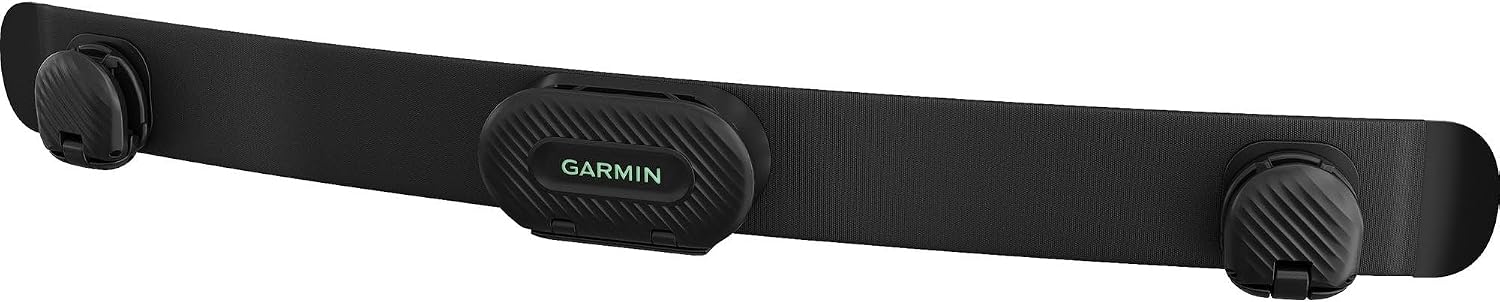
The Garmin HRM-Fit takes a structurally different approach: it’s engineered to clip directly onto a sports bra band rather than wrap around bare skin below the chest. The module (the hard plastic pod containing the sensor electronics) snaps into a fabric pocket built into the strap, which in turn attaches to the bra’s elastic band via silicone clips. According to Garmin’s published product documentation, the HRM-Fit is compatible with most sports bra bands between roughly 1 and 3.5 inches wide, covering the majority of standard athletic bra designs.
The Myzone Switch takes a hybrid path. It ships as a traditional chest strap but includes a clip accessory that allows the sensor pod to be repositioned — including attachment to a bra band or worn as an armband. The “Switch” name refers literally to this modularity. Per Myzone Group’s product overview, the sensor pod is the same hardware regardless of attachment method; you’re changing only the physical interface to your body.
The tradeoff that matters: Bra-mounted designs move with your bra, not independently. That’s a genuine mechanical advantage for electrode stability. The limitation is that you’re now dependent on bra band construction — a very tight compression band may place the sensor too firmly against the body; a looser lifestyle bra may not hold it securely enough. Owners of the HRM-Fit consistently report that pairing with a firm-band sports bra (versus a soft-cup style) produces the most stable signal during high-impact activity.
Accuracy, Connectivity, and the Specification Breakdown
Let’s be specific about what these devices actually measure and transmit, because “heart rate monitor” covers a wide range of capability.
By the numbers:
| Spec | Garmin HRM-Fit | Myzone Switch |
|---|---|---|
| Sensor type | Electrical (ECG-style chest electrode) | Electrical (ECG-style chest electrode) |
| Connectivity | ANT+ and Bluetooth | Bluetooth (Myzone app + BLE open broadcast) |
| Battery life | ~12 months (coin cell) | ~6 months (rechargeable) |
| Retail price (2026) | ~$109 USD | ~$120 USD |
| HRV support | Yes (via Garmin Connect) | Yes (via Myzone app) |
Both devices capture electrical heart rate — not optical (wrist-based LED sensing). That distinction matters because optical heart rate, used in smartwatches, estimates heart rate by shining light through your skin and measuring blood-flow pulsation. It’s convenient but introduces meaningful error during movement, particularly during interval training or strength work. Per PCMag’s roundup of the best heart rate monitors (Ziff Davis, 2025), chest electrical sensors consistently outperform optical wrist sensors for real-time accuracy during high-intensity exercise, often by 3–5 BPM or more at peak effort.
The Garmin HRM-Fit transmits on both ANT+ and Bluetooth simultaneously. For Garmin ecosystem users, this is seamless — it pairs directly to any Garmin watch or head unit with no configuration, while simultaneously feeding data to a Garmin Connect-linked phone. ANT+ also means compatibility with most modern Wahoo bike computers, Zwift setups, and a wide range of third-party fitness apps that support the protocol. Heart rate variability (HRV) data is recorded and surfaced in Garmin’s daily HRV Status feature, which requires a compatible Garmin watch as the receiving device.
The Myzone Switch operates primarily within the Myzone ecosystem. Its Bluetooth broadcast is open and can pair to many third-party apps, but the full feature set — including HRV insights, effort-point tracking (Myzone’s MEPs system), and workout history — requires the Myzone app and a Myzone subscription. That subscription cost is worth naming explicitly: as of mid-2026, Myzone’s premium tier runs approximately $9.99/month or $99/year. If you’re evaluating total cost of ownership, the Switch starts to look more expensive over a 24-month horizon than its sticker price suggests.
The HRM-Fit runs on a standard CR2032 coin cell rated for approximately 12 months at one hour of daily use. Replacement costs pennies. The Switch uses a built-in rechargeable battery rated at roughly six months per charge cycle — a cleaner experience day-to-day, but a battery that will eventually degrade with charge cycles, as all lithium cells do.
Who Each Device Is Actually Built For
This is where most comparison articles get vague. Let’s be direct.
The Garmin HRM-Fit is the right choice if:
You’re already in the Garmin ecosystem (or planning to be), you want to avoid subscription costs entirely, and you train in activities that involve significant upper-body movement — running, HIIT classes, rowing, cycling. The bra-clip design, per aggregated owner feedback cited in Wareable’s 2025–2026 heart rate monitor review, delivers noticeably more stable contact than a bare-skin strap for wearers who have historically struggled with strap migration. ANT+ dual-band transmission is also a genuine advantage for multi-device setups: you can feed your Garmin watch and a cycling computer simultaneously without pairing conflicts.
The HRM-Fit does not stream ECG waveform data or produce a rhythm strip. It reports beat-to-beat RR intervals (the raw timing data needed to calculate HRV) but not a full ECG trace. If your goal is a recording a cardiologist can interpret for arrhythmia screening, this device — like every consumer chest strap — is not the right tool. The AliveCor KardiaMobile 6L or clinical Holter-style recorders remain the appropriate category for that use case, as the American Heart Association’s guidance on heart rate monitoring (heart.org) consistently distinguishes between fitness monitoring and diagnostic rhythm documentation.
The Myzone Switch is the right choice if:
You train in a facility that has adopted the Myzone platform — many commercial gyms display real-time Myzone effort boards during group classes — and want full participation in that ecosystem’s social and effort-tracking features. The Switch’s modular form factor also makes it genuinely useful for wearers who alternate between bra-clip mounting during running and arm-band mounting during strength sessions where a chest strap would be uncomfortable. Myzone’s MEPs (Myzone Effort Points) system gamifies workout intensity in a way that motivates some athletes meaningfully; if that social-accountability layer matters to your training, the Switch delivers it in a way the HRM-Fit doesn’t.
The subscription consideration is real and not trivial. Over two years, a $99/year Myzone subscription adds roughly $200 to a $120 device — bringing effective total cost to ~$320 versus the HRM-Fit’s flat ~$109 with no ongoing fees. If you don’t actively use Myzone’s app platform, you’re overpaying for hardware that’s functionally equivalent to (or technically inferior in connectivity to) the HRM-Fit.
Fit Realities, Bra Compatibility, and What Owners Consistently Report
No specification sheet fully communicates what it’s like to actually secure one of these devices before a 45-minute interval run. Drawing from aggregated owner reviews across multiple retail platforms and editorial roundups including TechRadar’s chest strap guide (Future PLC, 2026), a few consistent themes emerge.
HRM-Fit owners report:
- Noticeably better strap stability during running compared to traditional bare-skin designs, particularly on torso geometries where standard straps previously migrated upward
- Occasional fit difficulty with racerback bra styles, where the band runs diagonally rather than horizontally — the clip attachment works best on horizontal bands
- The fabric strap needs periodic handwashing to maintain electrode conductivity; sweat buildup on the sensor surface is a known cause of erratic readings if cleaning is neglected
Myzone Switch owners report:
- The modular clip system requires a brief learning curve to seat the pod securely; poorly seated pods can produce dropout artifacts in the data
- In gym environments with the Myzone display ecosystem, the real-time effort feedback is genuinely engaging
- The rechargeable battery is convenient but adds a charging discipline requirement; dead-battery mid-session is a more common complaint with rechargeable wearables than with coin-cell designs
Neither device is rated for submersion-depth swimming. The HRM-Fit carries an IPX7 water-resistance rating (protected against temporary immersion up to 1 meter for 30 minutes, per Garmin’s published spec sheet), suitable for sweat and rain but not lap swimming. The Myzone Switch carries similar splash resistance. Swimmers seeking electrical chest-strap accuracy should look at Polar’s H10, which supports open-water swimming with onboard memory.
The Decision Rule
If you are a Garmin ecosystem user, train primarily in running, cycling, or HIIT formats, and want the most stable chest-electrical accuracy for HRV and training-zone tracking without a subscription: the HRM-Fit is the clear choice. Its bra-clip design addresses the core fit problem, its ANT+/BLE dual transmission is the most versatile in its price tier, and its total cost of ownership is the lowest in this comparison.
If you train in a Myzone-networked gym, value the social effort-accountability layer the MEPs system provides, and are comfortable with a subscription model that enables that ecosystem’s full feature set: the Switch earns its premium in that context. Run the 24-month math first — if the subscription lapses, the device’s differentiating value lapses with it.
If your goal is arrhythmia documentation or producing a recording for cardiologist review: neither device serves that purpose. Redirect to the AliveCor KardiaMobile 6L or an Emay-style multi-day Holter recorder — devices whose outputs are clinically structured for rhythm interpretation, a distinction the American Heart Association’s heart rate monitoring guidance explicitly draws.
The women’s-fit category has matured meaningfully. These are real engineering choices solving a real problem. The better question is no longer “does a women’s-specific strap work?” — it’s “which platform do I want to live inside?”