Your smartwatch already checks your heart rhythm when you remember to tap a button. But what if your heart’s most important moments — a flutter at 2 a.m., an irregular beat on mile eight of a long run — happen when no one’s recording? That’s the gap that continuous ECG chest monitors are designed to close. ECG stands for electrocardiogram, which is a measurement of the electrical signals your heart produces with every beat — the same signal a doctor reads during a clinical heart test, now captured by a small device you wear against your sternum. Unlike optical wrist sensors that infer heart activity from light bouncing off blood vessels, an electrical ECG from a chest-worn electrode is the gold-standard signal cardiologists actually use to diagnose arrhythmias (irregular heartbeats), track recovery, and measure subtle patterns like HRV (heart rate variability, a marker of stress and recovery quality). This article walks through two of the most-discussed consumer-grade continuous ECG chest monitors — the Frontier X2 and the Bioheart — compares them against each other and against the broader landscape, and ends with a plain “if X, then Y” decision framework so you can figure out which, if any, belongs in your monitoring stack.
Why “Always-On” ECG Changes the Calculus
Most people are already familiar with on-demand ECG — the 30-second recording you trigger on an Apple Watch or an AliveCor KardiaMobile by pressing a button. That workflow is excellent for symptomatic moments: you feel a palpitation, you capture it. But it has a structural weakness that cardiologists and serious athletes both recognize: the most clinically meaningful events are often asymptomatic, or they pass in seconds before you can reach for a device.
The Mayo Clinic’s overview of Holter monitoring makes this tension explicit — their standard recommendation for suspected arrhythmia is 24 to 48 hours of continuous recording precisely because intermittent capture misses events. Traditional clinical Holter monitors solve this with multi-lead adhesive patches that patients wear for one to two weeks, but they’re bulky, not waterproof, and not designed for athletic use.
Consumer continuous ECG monitors like the Frontier X2 and Bioheart are attempting to thread a difficult needle: clinical-grade electrical signal quality, in a form factor you’d actually wear through a workout and a night of sleep, at a consumer price point. That’s a hard engineering problem, and the tradeoffs are real — which is exactly what makes the category worth understanding carefully before you buy.
What continuous ECG actually adds to a monitoring stack:
- Detection of arrhythmias during sleep, when parasympathetic tone shifts and atrial fibrillation events often cluster
- Trend-level HRV data drawn from actual R-R intervals (the gap between heartbeats in an ECG trace), not optical estimation
- Exercise ECG data that persists through sweat, motion artifact, and high heart rates where wrist optical sensors notoriously struggle
- A longitudinal record that a cardiologist can scroll through, not just a 30-second PDF
Frontier X2: The Athletic Continuous ECG Benchmark
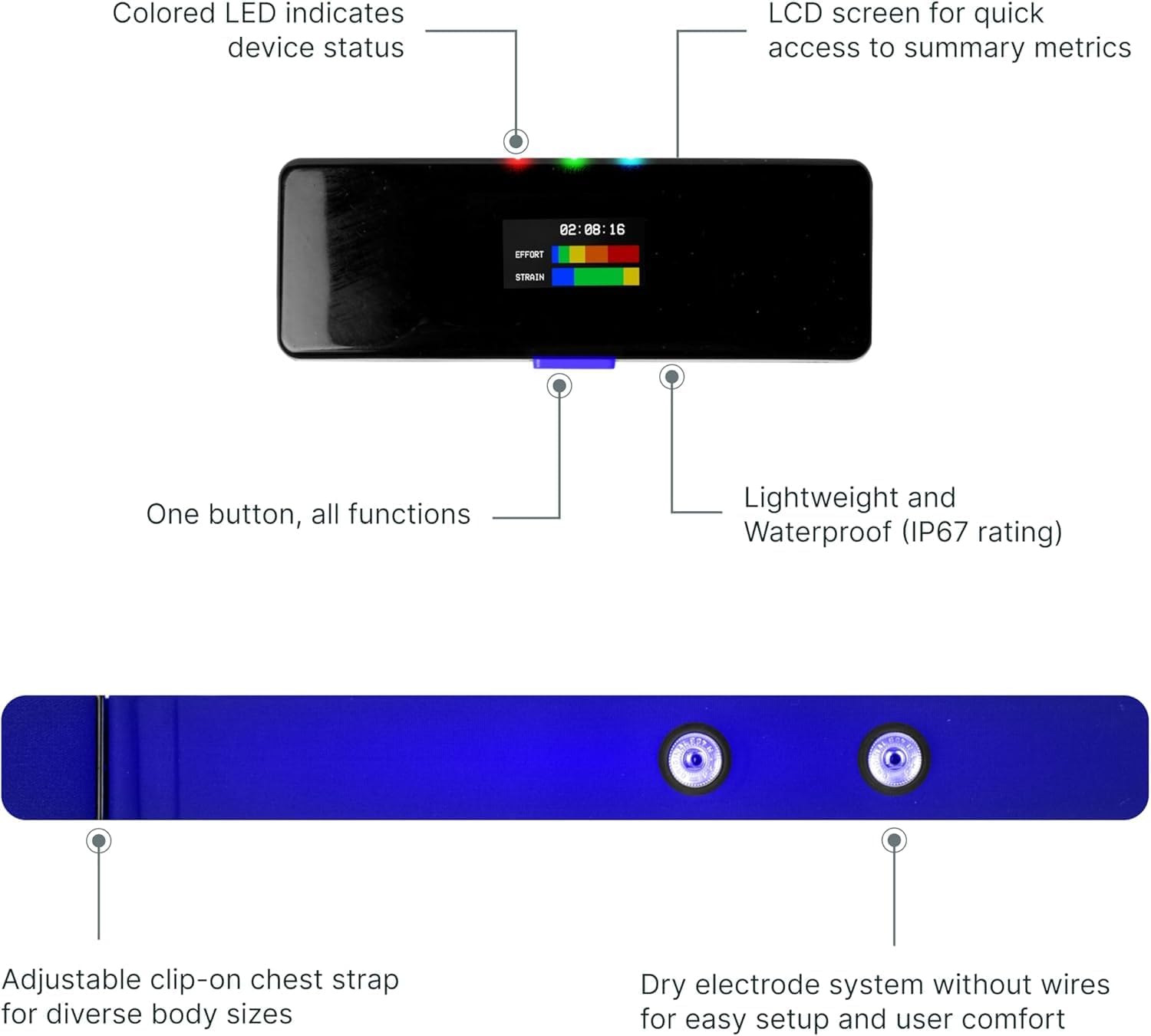
The Frontier X2 has become the reference point in this niche largely because it was one of the first consumer devices to combine continuous single-lead ECG recording with a sport-forward form factor — a small pod that clips to a chest strap or sticks directly to the sternum. Published specs put it at single-lead ECG captured at 200 Hz, with a battery life manufacturer-rated at approximately 24 hours of continuous recording before needing to charge.
What the spec sheet tells us:
| Spec | Frontier X2 |
|---|---|
| Signal type | Single-lead ECG (electrical) |
| Sample rate | 200 Hz |
| Battery (continuous) | ~24 hours |
| Form factor | Pod + chest strap or adhesive patch |
| App ecosystem | Frontier app (iOS/Android) |
| FDA clearance status | De Novo clearance (fitness/wellness; not a medical diagnostic device) |
The De Novo clearance point matters and deserves a direct call-out. Per the FDA’s 510(k) and De Novo database, the Frontier X2 holds a fitness/wellness-grade clearance — which means it’s been reviewed by the FDA as a consumer wellness product, but it is not cleared as a medical diagnostic device. That distinction has a practical consequence: the ECG traces it generates are excellent for personal trend monitoring, HRV analysis, and athletic performance tracking, but they are not a substitute for a physician-ordered Holter monitor, and most cardiologists will not act on the data as a clinical input in the same way they would a Holter or a KardiaMobile 6L recording.
Across aggregated owner reviews and coverage from Wareable’s 2025–2026 heart rate monitor roundup and TechRadar’s Frontier X2 deep-dive, the consistent pattern is high praise for exercise ECG quality — particularly the ability to capture clean traces at elevated heart rates where optical sensors produce noise — and recurring criticism of the companion app’s data export workflows. If you want to share data with a clinician, the current friction is real.
The total cost picture: the device itself is in the $250–$300 range. The Frontier ecosystem has historically offered premium app tiers for advanced analytics; prospective buyers should verify current subscription structure before purchase, as pricing has evolved. Replacement adhesive patches add ongoing consumable cost if you use the adhesive rather than the chest strap.
Bioheart: The Challenger Positioning for Clinical Crossover
The Bioheart monitor enters the same continuous ECG chest-worn space but with a design philosophy that leans slightly more toward clinical integration. Published materials describe it as a single-lead, continuous ECG patch system with a longer target wear duration than the Frontier X2’s ~24-hour cycle — some configurations are positioned for multi-day wear before charging or patch replacement, which edges it closer to a consumer Holter experience.
Where Bioheart differentiates itself in its marketing is the claimed physician-shareable output — the platform has emphasized PDF and data exports formatted with clinical legibility in mind. Harvard Health Publishing’s overview of wearable heart monitors notes that the key test for any consumer ECG device is whether the output is something a cardiologist can actually interpret and act on. PCMag’s ECG monitor coverage echoes this: the ability to generate a physician-readable report is a hard line between a wellness gadget and a clinically useful tool.
As of mid-2026, independent long-term owner reviews of the Bioheart are thinner than for the Frontier X2 — it’s a newer entrant with a smaller installed base — which means the aggregated signal on real-world reliability is still forming. The American Heart Association’s patient education materials on ECG monitoring consistently emphasize that the quality of the electrode-to-skin contact and consistent placement are the primary variables that determine trace quality in single-lead chest monitors; owners of the Bioheart who report high-quality traces tend to be meticulous about placement protocol.
Pricing and TCO note: Bioheart’s pricing as publicly listed sits in the $200–$350 range depending on configuration, with consumable patch costs if opting for longer wear periods. Anyone evaluating it seriously should confirm the current FDA clearance classification before making a clinical use decision — this category moves quickly, and clearance status can update between a product’s launch and its current commercial availability.
Head-to-Head: The Tradeoffs That Actually Drive the Decision
By the numbers — key comparison:
| Frontier X2 | Bioheart | |
|---|---|---|
| Continuous wear target | ~24 hrs (charge cycle) | Multi-day (config dependent) |
| Primary use case emphasis | Athletic performance + HRV | Cardiac monitoring + clinical sharing |
| FDA positioning | Fitness/wellness De Novo | Verify current status before purchase |
| App export for clinician | Friction reported by owners | Clinical-format PDF emphasized |
| Est. device price (2026) | ~$250–$300 | ~$200–$350 |
The honest frame here is that these two devices are currently optimized for different primary users within the same product category:
Frontier X2 is better matched to the athlete or fitness-focused quantified-self user who wants accurate, continuous ECG data to anchor HRV trends, training load analysis, and real-time exercise heart rate — and who doesn’t need the data to route to a cardiologist as a medical record.
Bioheart is better matched to someone with a documented cardiac concern who has a physician in the loop and needs data that can actually be presented at a follow-up appointment — particularly useful in the gap between a symptomatic event and a scheduled clinical Holter study, or for someone whose cardiologist is open to reviewing consumer-device ECG as supplementary data.
Neither is a replacement for a clinical-grade multi-day Holter if your cardiologist has actually ordered one. That point bears repeating plainly: per Mayo Clinic’s Holter monitor overview, physician-ordered Holter and event monitors remain the clinical standard for arrhythmia diagnosis, and consumer devices — however sophisticated — occupy a supplementary role unless your physician has specifically cleared the device’s output as acceptable clinical input.
The Decision Framework: If X, Then Y
If you’re still deciding, run yourself through this logic:
If your primary goal is athletic performance and HRV optimization, and you have no documented cardiac condition: The Frontier X2 is the stronger choice in this category. The athletic form factor, exercise ECG quality, and HRV analytics align directly with that use case. Budget for the app tier and replacement consumables.
If you have a documented arrhythmia concern and need physician-shareable output: Start with a device that already has established clinical acceptance first — the AliveCor KardiaMobile 6L (~$150) remains the category benchmark for FDA-cleared, cardiologist-accepted ECG recordings. The Bioheart is worth evaluating alongside it if you want continuous rather than on-demand capture, but confirm its current FDA status and run the export format past your cardiologist before committing.
If you want both — continuous athletic ECG plus clinical-grade documentation: You may genuinely need two devices in the stack. The math on that isn’t as absurd as it sounds: a KardiaMobile 6L at ~$150 for on-demand clinical-quality snapshots, plus a Frontier X2 for always-on athletic monitoring, lands you under $500 combined — less than many single-device clinical monitors and covering more ground than either alone.
If you’re a caregiver managing a family member’s arrhythmia remotely: Neither of these devices is the right tool. Look instead at the Wellue DuoEK (~$200) or the Emay EMG-10, both of which are positioned for extended Holter-style recordings with outputs explicitly designed for physician review.
The continuous ECG chest monitor category is maturing fast. The fundamentals, though, remain stable: electrical beats optical for signal quality, continuous beats episodic for rare-event capture, and FDA clearance level still determines what a cardiologist will act on. Match the device to the actual job, and the investment pays off. Match it to the wrong one, and even a $400 monitor becomes an expensive fitness tracker.